

A trauma bond is not a sign of weakness. It does not mean you enjoy being mistreated, and it certainly does not mean you are incapable of healthy love.
Instead, it is a powerful psychological attachment that develops through repeated cycles of affection, fear, emotional pain, and temporary relief.
Over time, your brain begins to associate the abusive relationship with both danger and comfort.
Consequently, leaving the relationship becomes emotionally confusing, even when you know it is harming you.
Many survivors blame themselves for staying too long. However, modern psychology tells a very different story.
The emotional pull of a trauma bond is rooted in the way the human brain responds to unpredictable rewards, chronic stress, and attachment.
Understanding these mechanisms is often the first step toward recovery.
In this article, we will explore the psychology behind a trauma bond, why it forms, and why breaking free is far more complicated than simply deciding to walk away.
EMERGENCY HELP
If you are in immediate danger, contact your local emergency services or a trusted person who can help you reach safety.U.S. Domestic Violence Support:
The National Domestic Violence Hotline provides free, confidential, 24/7 support.
Call: 1-800-799-SAFE (7233)
Text:
START to 88788
Online: The National Domestic Violence Hotline.
If you are outside the United States, contact your country’s domestic violence or emergency support service.
What Is a Trauma Bond?
A trauma bond is a powerful emotional attachment that can develop between a person experiencing abuse and the person harming them.
It is often strengthened by a cycle of abuse, fear, reconciliation, affection, and intermittent reinforcement, making it difficult to leave even when the relationship is harmful.
Trauma bonding describes an attachment that can develop in abusive relationships where periods of mistreatment are interrupted by affection, apologies, promises, or apparent calm.
The attachment can feel confusing because the same person may be experienced as both a source of fear and a source of comfort.
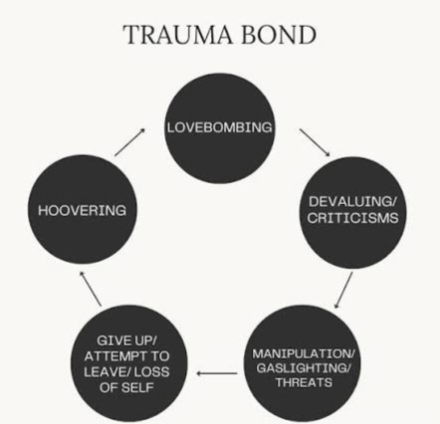
This early stage creates emotional safety and deep trust. As a result, the victim lowers their emotional defenses and begins investing heavily in the relationship.
Eventually, the pattern changes.The warmth becomes criticism.The affection becomes emotional distance.The promises become manipulation.
Then, just when the victim begins pulling away, the abuser suddenly becomes loving again.
They apologize, become affectionate, or offer hope that things will improve.This brief return of kindness feels incredibly rewarding because it follows emotional pain.
Consequently, the victim becomes even more emotionally attached. Over time, this repeating cycle strengthens the trauma bond until leaving the relationship feels almost impossible.
Importantly, this pattern is not limited to romantic relationships. A trauma bond can also develop between parents and children, family members, close friends, employers, religious leaders, or anyone who repeatedly alternates care with psychological harm.
The Psychology Behind a Trauma Bond
A trauma bond is far more than an emotional habit.
It is the result of several psychological processes working together.One of the most influential concepts comes from psychiatrist Dr. Judith Herman, whose groundbreaking work on psychological trauma changed how mental health professionals understand survivors of chronic abuse.

In her book Trauma and Recovery, she explained that prolonged interpersonal trauma affects not only emotions but also a person’s identity, sense of safety, and ability to trust others.
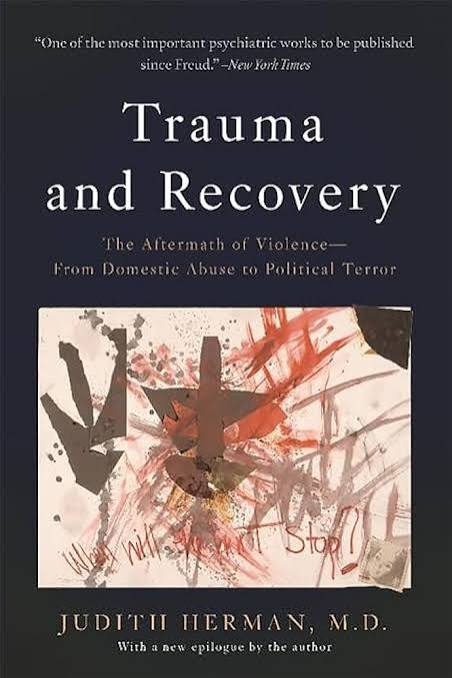
According to this perspective, survivors often remain emotionally attached because abuse gradually changes how they interpret danger, hope, and relationships.
Instead of seeing the abuse as unacceptable, they begin searching for ways to restore the loving version of the person they first met.
In other words, they are not chasing the abuse.They are chasing the memory of who the abuser appeared to be in the beginning.
This psychological conflict creates enormous emotional confusion.
On one hand, the survivor recognizes the harm. On the other hand, they continue hoping the relationship will return to its early stage.
That hope becomes one of the strongest forces maintaining a trauma bond.
Why the Brain Holds On to a Trauma Bond
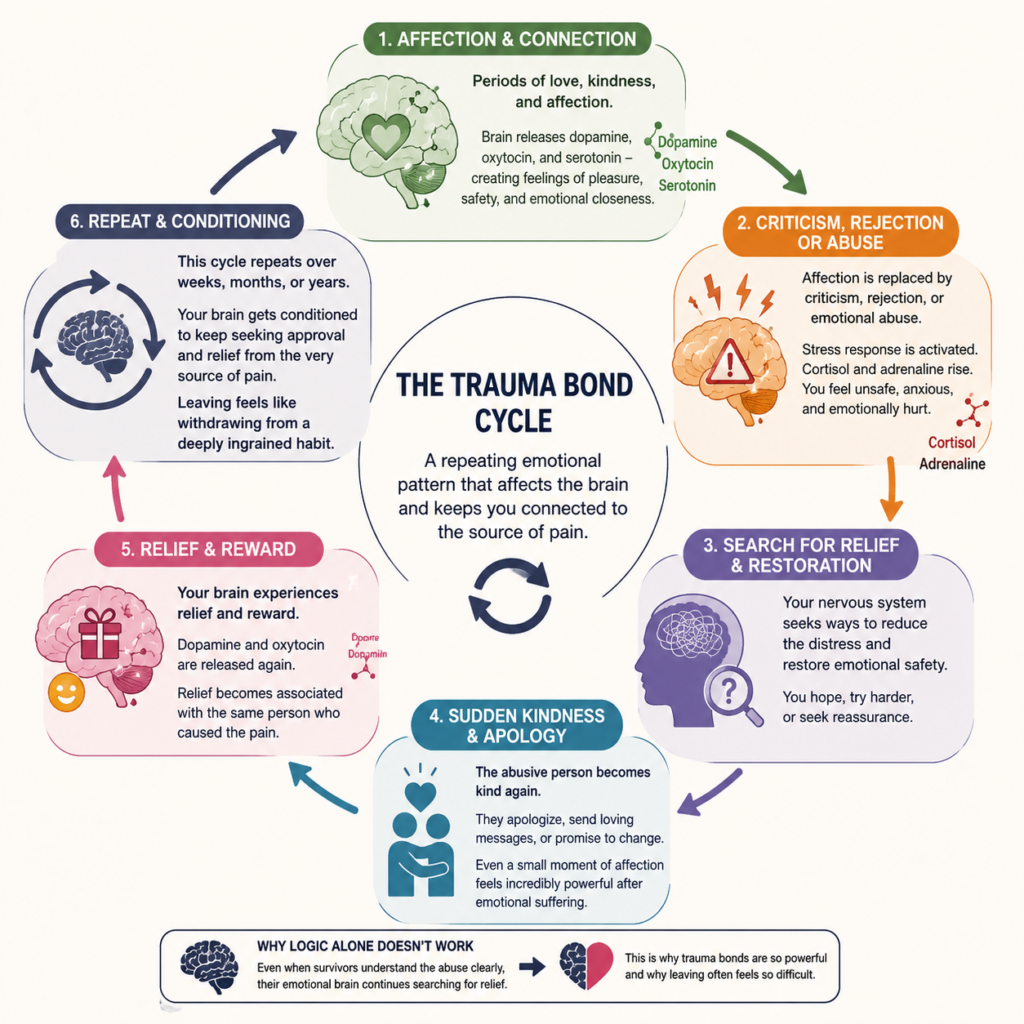
A trauma bond cannot be reduced to a single chemical or brain region. Instead, several interacting systems involved in reward, attachment, threat detection and stress may contribute to why an abusive relationship can become psychologically difficult to leave.
Dopamine Reward Loops
Dopamine is involved in motivation, reward learning and reinforcement.
In an unpredictable relationship, positive moments may become especially salient because they occur after periods of distress.
When affection, attention or reconciliation follows mistreatment, the contrast can create powerful reinforcement.
The brain may learn to continue seeking the next positive interaction despite the overall harmful pattern.
This is one reason intermittent reinforcement is important when explaining trauma bonding.
Oxytocin and Attachment
Oxytocin is involved in social bonding and attachment, although its effects are complex and strongly influenced by context.
Research examining trauma and oxytocin suggests that traumatic experiences can interact with oxytocin-related systems and the body’s stress-regulation systems.
Therefore, it is more accurate to say that oxytocin may participate in attachment-related processes rather than claiming that oxytocin itself creates a trauma bond.
Cortisol and the Stress Response
Cortisol is one of the hormones involved in the body’s stress response.
Repeated exposure to fear, conflict or unpredictability can repeatedly activate stress-response systems.
Over time, the person may become highly focused on detecting whether the next interaction will bring danger or relief.
This can contribute to a cycle in which moments of calm feel unusually significant.
Trauma research also indicates that traumatic experiences can affect systems involving the hypothalamic-pituitary-adrenal axis, which regulates stress responses.
Amygdala Reactivity
The amygdala plays an important role in processing emotionally significant information, particularly threats and fear-related cues.
In an abusive environment, the brain may become highly attentive to changes in tone, facial expressions, behavior and other signals that could indicate danger.
This heightened threat monitoring can make the relationship psychologically exhausting while also keeping the person intensely focused on the abuser.
The important point is that trauma bonding is not simply a matter of “knowing better.” Emotional learning, attachment, reward and threat systems can interact in complicated ways.
Trauma Bond and Intermittent Reinforcement
Psychologists have long understood that unpredictable rewards create stronger habits than rewards given consistently.
This principle is known as intermittent reinforcement.
Imagine a slot machine in a casino.If it paid every single time, the experience would quickly become ordinary.
However, because the reward comes unexpectedly, people continue playing, believing the next attempt might finally pay off.
Emotionally abusive relationships often operate in a surprisingly similar way.The survivor never knows when affection will return.
One day the abuser is distant.The next day they are loving.Then they become cold again.
Because kindness appears unpredictably, every small act of affection feels unusually meaningful.
As a result, hope becomes stronger than reality.Instead of evaluating the relationship based on the overall pattern, the survivor begins focusing on rare moments of warmth.
Consequently, the trauma bond grows stronger with every cycle.
Let’s Understand trauma bond with an example
Imagine a woman named Alina.
During the first six months of her relationship, her partner treated her with extraordinary kindness.
He planned thoughtful dates, spoke about marriage, and constantly reassured her that she was the love of his life.
Gradually, his behavior changed.He criticized her appearance, ignored her messages for days, and blamed her whenever conflicts arose.
Whenever Alina finally reached her breaking point, he suddenly returned with flowers, heartfelt apologies, and promises that everything would be different.
For a few weeks, the relationship felt wonderful again.Then the cycle repeated.
After several years, Alina no longer stayed because she enjoyed the relationship.
She stayed because her mind had become emotionally conditioned to believe that enduring pain was the price of receiving love.
This is the hidden power of a trauma bond.The relationship no longer depends on consistent love.
Instead, it survives because unpredictable hope keeps replacing certainty.
Why Understanding a Trauma Bond Matters
Many survivors believe they are simply “too attached.
“Others think they are weak, overly emotional, or incapable of moving on.
Research and clinical experience suggest otherwise.
A trauma bond affects the brain, emotions, attachment system, and stress response simultaneously.
Therefore, recovery requires much more than willpower.
The good news is that what the brain learns, it can also gradually unlearn.
Recovery begins the moment you stop asking,
“Why can’t I leave?”
and start asking,
“What happened to my mind that made leaving so difficult?”
Signs of a Trauma Bond
A trauma bond rarely develops overnight. Instead, it grows gradually through repeated cycles of affection, disappointment, emotional pain, and reconciliation.
Consequently, many survivors do not recognize what is happening until they feel emotionally trapped.You may be experiencing a trauma bond if you notice several of the following signs.
You Defend Someone Who Continues to Hurt You
Perhaps the clearest sign is repeatedly making excuses for abusive behavior.
You tell yourself they had a difficult childhood.You believe they are under stress.You convince yourself they did not mean what they said.
Although compassion is an admirable quality, it becomes harmful when it repeatedly silences your own pain.
Eventually, you spend more energy understanding the abuser than understanding yourself.
You Miss Them Even After They Hurt You
Most healthy relationships become easier to leave when emotional abuse continues.
However, a trauma bond often creates the opposite reaction.The more the relationship hurts, the stronger your emotional longing becomes.
This contradiction confuses many survivors. They wonder why they still love someone who constantly disappoints them.
The answer is that your nervous system has learned to associate the person with both fear and relief.
Therefore, missing them does not necessarily mean they were good for you. Instead, it often reflects the conditioning created by repeated emotional highs and lows.
You Feel Responsible for Fixing the Relationship
Another common sign is believing that everything depends on your effort.You try harder.
You communicate more carefully.You become increasingly patient.You sacrifice your own needs.
Nevertheless, the relationship continues following the same painful pattern.
Healthy relationships involve shared responsibility. In contrast, abusive relationships often convince one partner that they alone must repair everything.
You Constantly Wait for the Person They Used to Be
Many survivors say,”I just want the person I met in the beginning to come back.”
This statement reveals something important.The relationship is no longer built on the present reality.
Instead, it survives because of hope connected to the past.The early stage of affection becomes the emotional standard against which every future interaction is measured.
Consequently, survivors continue waiting for a version of the person that may never truly have existed beyond the initial phase of the relationship.
Why Intelligent People Develop a Trauma Bond
One of the biggest myths about a trauma bond is that only weak or dependent people experience it.
Clinical experience suggests otherwise.Psychologists work with doctors, lawyers, teachers, executives, therapists, and highly educated individuals who have struggled to leave abusive relationships.
Intelligence does not protect the human attachment system.The brain evolved to create close emotional bonds because strong relationships increased survival throughout human history.
Unfortunately, manipulative individuals can exploit these natural attachment mechanisms.
Therefore, developing a trauma bond is not a sign of low intelligence.It is evidence that your normal human capacity for attachment has been repeatedly manipulated.
Attachment Theory Helps Explain Trauma Bond
The work of British psychiatrist John Bowlby, the founder of Attachment Theory, transformed our understanding of close relationships.

According to Attachment Theory, human beings are biologically wired to seek safety through emotional connection.
During healthy relationships, secure attachment creates trust, comfort, and emotional stability.
However, inconsistent affection produces uncertainty.When love becomes unpredictable, many people begin working harder to regain emotional closeness.
Ironically, the less affection they receive, the more desperately they pursue it.
This explains why a trauma bond often becomes stronger after emotional distance, silent treatment, or rejection.
Instead of giving up, the attachment system increases efforts to restore the relationship.
Unfortunately, this natural survival response often benefits the abusive partner.
Why Narcissistic Relationships Create Strong Trauma Bonds
Not every unhealthy relationship creates a trauma bond, but narcissistic relationships often contain the ingredients that make trauma bonding more likely.
The relationship usually follows a repeating cycle.First comes idealization.You feel deeply loved, admired, and emotionally special.Next comes devaluation.
Criticism increases.Your confidence declines.Nothing you do seems good enough.Finally comes reconciliation.The narcissistic partner becomes affectionate again, offers hope, or briefly behaves like the person you first met.This cycle repeats again and again.Eventually, emotional stability depends almost entirely on the narcissistic partner’s approval.As a result, your own identity gradually becomes smaller while the relationship becomes the center of your emotional world.
The Hidden Role of Shame
Many survivors remain trapped because of shame rather than love.
They ask themselves,”How did I allow this to happen?””What will other people think?””What if everyone says I should have left sooner?”
These thoughts create silence.Silence creates isolation.Isolation strengthens the trauma bond because the abusive partner becomes the primary source of emotional connection.
Breaking this cycle often begins when survivors share their experiences with someone safe, trustworthy, and nonjudgmental.
Trauma Bond Is Not the Same as Love
Love encourages growth.Love respects boundaries.
Love allows disagreement without punishment.Love creates emotional safety.A trauma bond, however, creates anxiety, confusion, fear, and emotional dependence.
You spend more time trying to avoid conflict than enjoying connection.
You celebrate brief moments of kindness because they have become so rare.
Eventually, survival replaces intimacy.Recognizing this difference is painful.
Nevertheless, it is also one of the most important turning points in recovery.
Clinical Perspective
From a clinical standpoint, a trauma bond is not listed as a separate diagnosis in the Diagnostic and Statistical Manual of Mental Disorders (DSM 5).
However, mental health professionals frequently observe trauma bonding in survivors of domestic abuse, coercive control, cult involvement, human trafficking, and emotionally abusive relationships.
Depending on the individual’s symptoms, a licensed mental health professional may evaluate for conditions such as post traumatic stress disorder, complex trauma, anxiety disorders, depression, or adjustment disorders.
Because every survivor’s experience is unique, an accurate assessment by a qualified clinician is essential before beginning treatment.
How to Break a Trauma Bond and Reclaim Your Life
Breaking a trauma bond requires patience. There is no overnight cure, but there is a clear path forward.
Accept the Reality Instead of the Fantasy
The hardest part of recovery is accepting that the person you hoped they would become may never exist.
Many survivors stay attached to potential rather than reality.
Ask yourself one question:”Am I in love with who they consistently are, or who I keep hoping they will become?”
This question often reveals the difference between genuine love and emotional dependency.
Stop Looking for Closure From the Abuser
One of the biggest mistakes survivors make is expecting the person who caused the wound to heal it.
A narcissistic or emotionally abusive person may never admit what they did.
They may deny it, minimize it, or blame you instead.
Waiting for an apology keeps the trauma bond alive because your emotional healing remains dependent on someone else.
Real closure begins when you accept that your peace no longer depends on their understanding.
Create Emotional Distance
When it is safe and practical, reducing or ending contact allows your nervous system to calm down.
For survivors who share children, workplaces, or legal responsibilities with the abusive person, complete no contact may not be possible.
In those situations, many therapists recommend maintaining clear boundaries and limiting communication to essential topics.
Every healthy boundary weakens the trauma bond and strengthens your sense of self.
Rebuild Your Identity
Many survivors lose touch with the person they were before the relationship.
Perhaps you stopped painting.Perhaps you abandoned your studies.
Perhaps you withdrew from friends or family.
Recovery involves rediscovering the parts of yourself that existed before the abuse.
Small actions matter.Read the books you postponed.Take a walk every morning.Learn a new skill.
Reconnect with supportive people.Each healthy choice reminds your brain that life exists beyond the relationship.
Train Your Brain to Tolerate Peace
A nervous system that has lived in constant emotional chaos often mistakes calmness for boredom.
This surprises many survivors.After leaving an abusive relationship, healthy people may initially seem less exciting simply because they are emotionally consistent.
Healing means allowing your brain to become familiar with stability.
Over time, peace begins to feel normal instead of unfamiliar.
Therapy Can Help Break a Trauma Bond
Recovering from a trauma bond does not always require therapy, but many survivors find professional support life changing.
A licensed psychologist or trauma informed therapist can help identify unhealthy relationship patterns, process painful memories, strengthen emotional boundaries, and rebuild self esteem.
Depending on the individual’s needs, evidence based approaches may include Cognitive Behavioral Therapy, Eye Movement Desensitization and Reprocessing, trauma focused therapies, or attachment based psychotherapy.
Seeking therapy is not a sign of weakness.It is an investment in long term emotional health.
Medication and Clinical Perspective
There is currently no medication that treats a trauma bonditself.
However, prolonged emotional abuse can contribute to depression, anxiety disorders, panic attacks, insomnia, or post traumatic stress symptoms.
In these situations, a psychiatrist or another qualified medical professional may recommend medication to reduce specific symptoms while psychotherapy addresses the underlying trauma.
Medication should never be started or stopped without medical supervision.The purpose of medication is not to erase memories.
Instead, it may reduce symptoms enough for therapy and daily functioning to become more manageable.
A Different Way to Measure Healing
Many people believe recovery means never thinking about the abusive person again.
That is unrealistic.
A healthier way to measure progress is to notice how much power those memories still have over your decisions.
Healing becomes visible when:
You no longer feel responsible for saving them.
You stop blaming yourself for their behavior.
You recognize manipulation more quickly.
You trust your own judgment again.
You choose peace instead of emotional chaos.
Recovery is rarely linear.Some days will feel difficult.Nevertheless, every healthy decision weakens the trauma bond and strengthens your future.
Related Articles
What Is Real Depression? How Clinical Depression Is Different?
Why You Overthink Everything: The Psychology Behind It
Gaslighting in Relationships: How Manipulation Works
Are you Living in Survival Mode
Why Does a Narcissist Come Into the Life of an Empath?
FAQs
Trauma bonds often develop because of intermittent reinforcement, where periods of kindness and love are mixed with emotional, verbal, or physical abuse. This unpredictable pattern creates a powerful emotional dependency.
Common signs include feeling unable to leave an abusive relationship, constantly making excuses for the abuser, craving their approval, blaming yourself for their behavior, and returning after repeated breakups.
There is no fixed timeline. Recovery depends on the severity of the abuse, the length of the relationship, and the support available. With therapy, education, and strong boundaries, healing becomes possible over time.
Yes. Trauma bonds often feel like intense love because the emotional highs and lows create a powerful attachment. However, healthy love is based on trust, respect, safety, and consistency rather than fear and manipulation.
References
- Dutton, D. G., & Painter, S. (1993). Emotional attachments in abusive relationships: A test of traumatic bonding theory. Violence and Victims, 8(2), 105–120. https://doi.org/10.1891/0886-6708.8.2.105. PubMed PMID: 8193053.
- Dutton, D. G., & Painter, S. (1993). The battered woman syndrome: Effects of severity and intermittency of abuse. American Journal of Orthopsychiatry, 63(4), 614–622.
- Effiong, J. E., Ibeagha, P. N., & Iorfa, S. K. (2022). Traumatic bonding in victims of intimate partner violence is intensified via empathy. Journal of Social and Personal Relationships, 39(12), 3619–3637.
- American Psychological Association. (2025). Professional practice guidelines for psychologists in the assessment of psychological trauma in adults.
Reviewed by Ainna Ross
This article is grounded in published psychological research and my own experience recovering from narcissistic abuse. Read more about my background. It's for educational purposes only and isn't a substitute for professional diagnosis or care.
