
ADHD, or attention deficit hyperactivity disorder, is often reduced to a simple idea: a person cannot concentrate.
That explanation is far too shallow.
A person with ADHD may be able to concentrate intensely for hours on something that genuinely interests them, yet struggle to begin a simple task that feels boring. They may remember a conversation from ten years ago but forget where they placed their phone five minutes ago. They may understand exactly what needs to be done, genuinely want to do it, and still find themselves unable to begin.
This apparent contradiction is one of the most misunderstood aspects of ADHD.
ADHD is a neurodevelopmental condition that can affect attention, impulse control, activity level, emotional regulation, working memory, planning, organization and the ability to translate intentions into consistent action. Although symptoms usually begin during childhood, ADHD can continue into adolescence and adulthood.
More importantly, ADHD is not simply a problem of laziness, poor discipline or lack of intelligence.
It is a condition involving complex interactions between brain development, genetics, cognition, behavior and environment.
Understanding ADHD therefore requires looking beyond the stereotype.
What Is ADHD?
ADHD is a neurodevelopmental disorder characterized by persistent patterns of inattention, hyperactivity and impulsivity that interfere with everyday functioning
However, ADHD does not look identical in every person.
Some people mainly experience difficulties with attention and organization. Others experience significant impulsivity and hyperactivity. Many experience a combination of symptoms.
According to current clinical guidance, symptoms must cause meaningful impairment rather than simply representing occasional forgetfulness or restlessness. Diagnosis also requires consideration of symptoms across different settings and a careful assessment of alternative explanations.
This distinction matters.
Everyone loses concentration sometimes.
Everyone procrastinates sometimes.
Everyone occasionally forgets an appointment.
ADHD becomes clinically significant when these patterns are persistent, developmentally inappropriate and disruptive enough to affect education, employment, relationships, family life or other important areas of functioning.
ADHD Is Not Simply a Lack of Attention
One of the biggest misconceptions about ADHD is that people with the condition have no attention.
In reality, the problem can be better understood as difficulty regulating attention.
For example, imagine a university student who spends three hours researching a topic that fascinates her. She becomes completely absorbed and barely notices the passage of time.
The next day, however, she needs to complete a routine assignment.
She knows the deadline.
She understands the instructions.
She even wants to finish it.
Yet she repeatedly checks her phone, gets up to make tea, opens another browser tab and suddenly realizes that two hours have passed.
Someone watching her may conclude:
“She can focus when she wants to.”
But that conclusion misses the central issue.
The ability to focus on something interesting does not necessarily mean the person can voluntarily regulate attention across different tasks.
This is one reason ADHD is frequently misunderstood.
ADHD and Executive Function
To understand ADHD more deeply, we also need to understand executive function.
Executive functions are the mental processes that help us organize behavior toward a goal. They help us hold information in working memory, inhibit impulses, regulate emotions, plan, prioritize, initiate actions and monitor our behavior.
Clinical neuropsychologist Russell A. Barkley has made major contributions to the understanding of ADHD and self regulation.

His work has strongly emphasized the relationship between ADHD, inhibition and executive functioning.
Barkley’s work helped move the discussion away from the simplistic idea that ADHD is merely an attention problem.
Instead, researchers and clinicians increasingly examine how ADHD can affect the ability to regulate behavior over time.
This explains an important experience reported by many people with ADHD:
“I know what I should do, but I cannot consistently make myself do it.”
That difference between knowing and doing can be psychologically exhausting.
ADHD Symptoms Can Be More Subtle Than People Realize
The most recognizable image of ADHD is a physically restless child who cannot sit still.
However, ADHD symptoms can be much quieter.
A person may appear calm while internally experiencing constant mental movement.
Common ADHD symptoms can include:
- Difficulty sustaining attention
- Frequently losing belongings
- Forgetting appointments
- Difficulty completing tasks
- Procrastination
- Poor time management
- Frequently changing activities
- Difficulty organizing work
- Interrupting conversations
- Acting before thinking
- Difficulty waiting
- Restlessness
- Difficulty following lengthy instructions
- Frequently making careless mistakes
- Difficulty maintaining routines
However, having several of these experiences does not automatically mean someone has ADHD.
Sleep deprivation, anxiety, depression, trauma, stress, substance use and certain learning difficulties can produce symptoms that resemble ADHD. Therefore, proper assessment matters.
ADHD in Children
ADHD in children often becomes visible through school and family life.
A child may understand a lesson but fail to complete homework.
Another child may repeatedly interrupt teachers.
Someone else may constantly lose school supplies.
However, children with ADHD are sometimes labeled as naughty, careless or deliberately difficult.
That interpretation can create another problem
If adults repeatedly tell a child:
- “You are lazy.”
- “You never listen.”
- “You could do it if you tried.”
- “You are careless.”
The child may eventually stop seeing the problem as something they struggle with and start seeing it as something fundamentally wrong with who they are.
That difference is psychologically important.
Clinical guidelines emphasize that assessment should consider information from multiple settings and should also evaluate coexisting conditions such as anxiety, depression, learning disorders, autism spectrum conditions and other developmental or behavioral difficulties.
Therefore, an ADHD diagnosis should never be based simply on a teacher saying that a child is distracted.
The clinician needs a broader picture.
ADHD in Adults
ADHD does not necessarily disappear when childhood ends.
Instead, the presentation can change.
An adult may not be physically hyperactive in the way a young child is. Instead, hyperactivity may appear as internal restlessness, constant activity, difficulty relaxing or an inability to tolerate inactivity.
Adults with ADHD may struggle with:
- Managing deadlines
- Maintaining routines
- Household organization
- Financial organization
- Workplace responsibilities
- Long meetings
- Time perception
- Relationship communication
- Emotional impulsivity
- Starting important tasks
- Completing projects
- Remembering appointments
According to current clinical guidance, adults presenting with possible ADHD should receive a comprehensive assessment that considers developmental history, current functioning and alternative explanations.
The CDC also notes that ADHD begins during childhood but may look different in adulthood.
This is particularly important for adults who grew up before ADHD was widely recognized.
Some adults have spent decades interpreting their difficulties as personal failure.
They may have been intelligent children who performed well academically but struggled with organization.
They may have developed elaborate coping strategies.
They may have become extremely dependent on deadlines.
They may repeatedly wait until pressure becomes intense enough to initiate action.
As a result, their ADHD can remain hidden behind achievement.
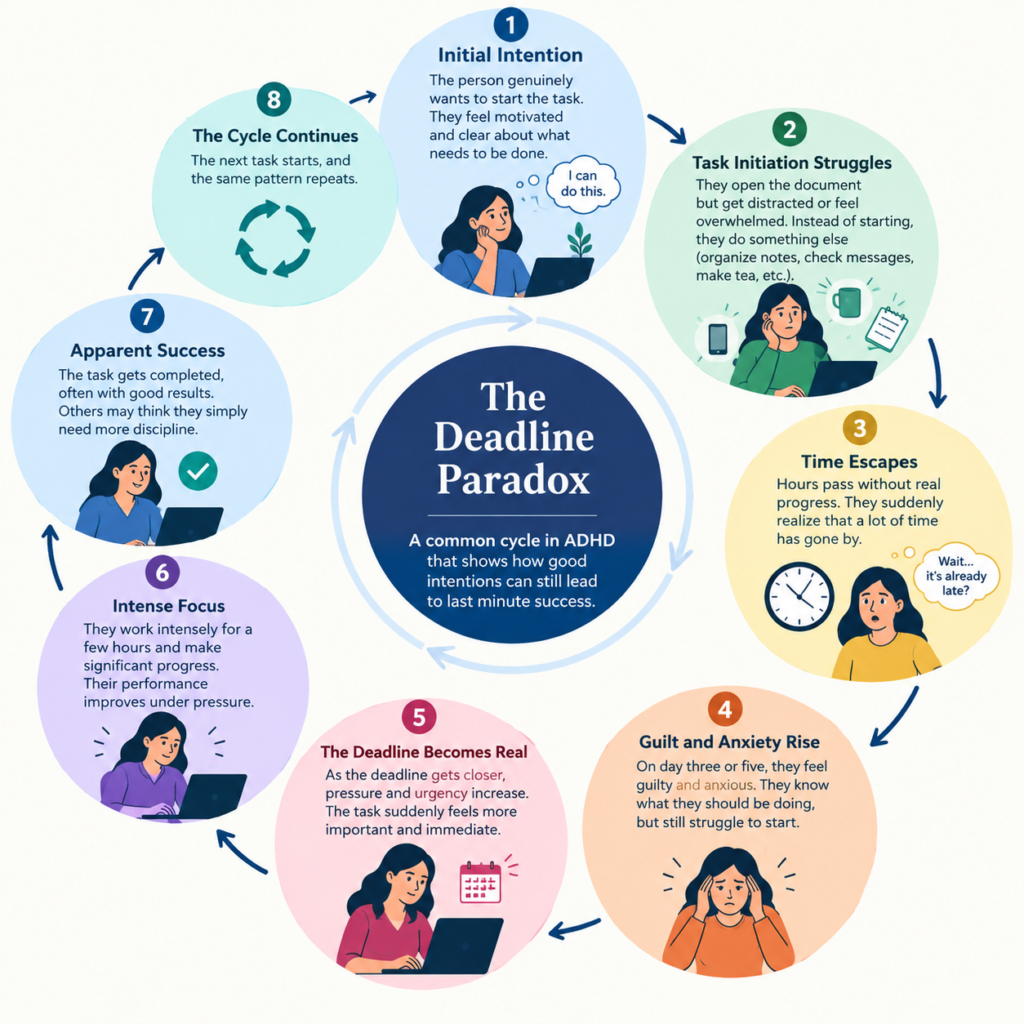
The Deadline Paradox
Consider a fictional person named Sara.
Her manager gives her seven days to complete a report.
On day one, Sara genuinely intends to begin.
She opens the document.
Then she thinks she should organize her notes first.
She organizes her notes.
Then she checks one message.
That message leads to another task.
By evening, she has completed several small things but not the important report.
On day three, she feels guilty.
On day five, anxiety increases.
On day six, something changes.
The deadline becomes immediate.
Suddenly Sara works intensely for six hours and produces excellent work.
Her manager thinks:
“If she can produce excellent work under pressure, she simply needs discipline.”
But that interpretation may be wrong.
The pattern can reflect difficulties with task initiation, time regulation, reward sensitivity and executive functioning.
The deadline has changed the psychological conditions surrounding the task.
Now the consequence is immediate.
The task feels urgent.
The level of stimulation is higher.
The problem was never necessarily an inability to understand the work.
The problem may involve difficulty consistently translating intention into action.
This is one reason ADHD can look so contradictory from the outside.
What Happens in the ADHD Brain?
There is no single “ADHD brain.”
This point is important because popular discussions often oversimplify neuroscience.
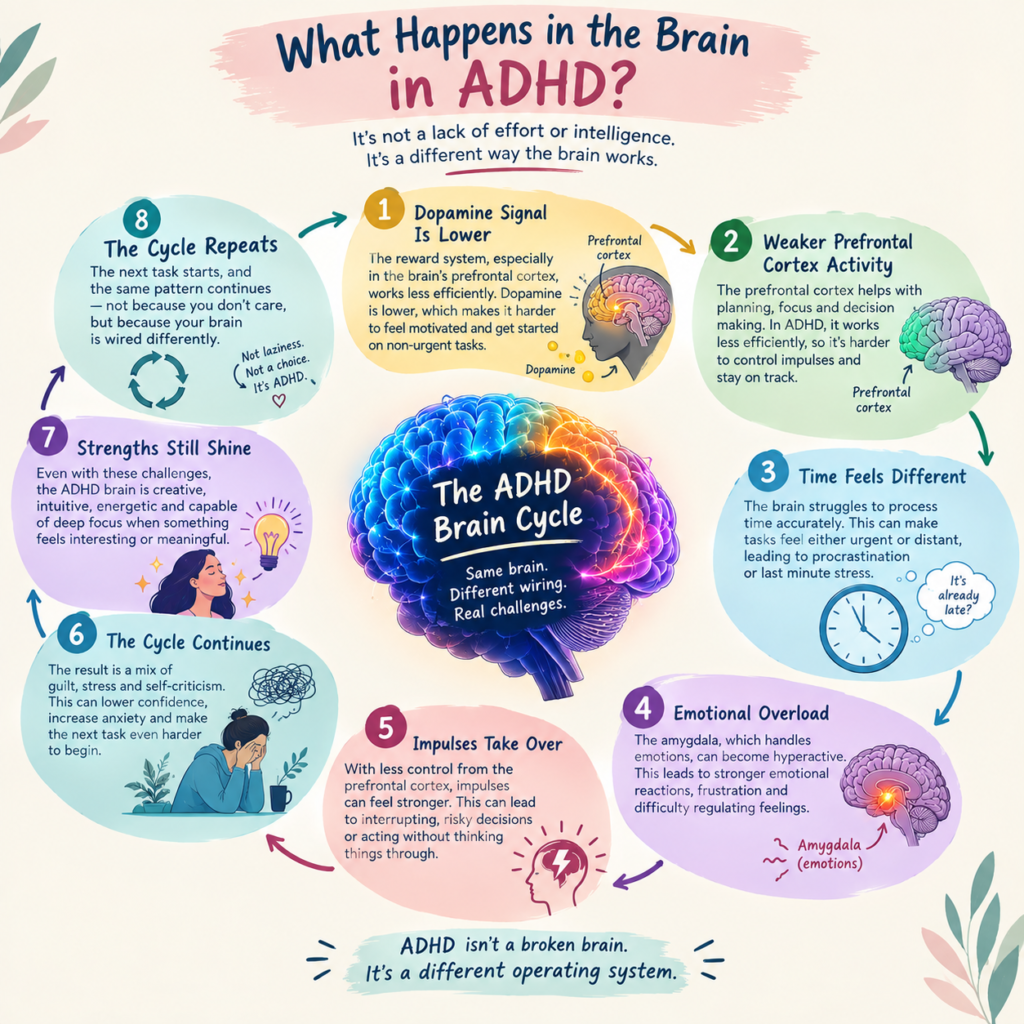
Research suggests that ADHD involves complex differences across brain networks, neurotransmitter systems and developmental processes. Current evidence also points toward substantial genetic contributions, although ADHD does not result from one single gene.
Dopamine and norepinephrine are particularly relevant to current models of ADHD.
Dopamine and norepinephrine are particularly relevant to current models of ADHD.These neurotransmitter systems participate in processes involving motivation, attention, arousal, learning and behavioral regulation.
However, it would be inaccurate to say that ADHD simply means “low dopamine.”
That popular statement is an oversimplification.
Modern neuroscience increasingly views ADHD as a heterogeneous condition involving multiple interacting systems rather than one isolated brain chemical or brain region. A 2024 review in Nature Reviews Neuroscience emphasized the complexity of ADHD neurobiology and argued against reducing the condition to a single localized mechanism.
Therefore, a better explanation is that ADHD involves differences in networks supporting attention, self regulation, motivation and executive functioning.
Therefore, a better explanation is that ADHD involves differences in networks supporting attention, self regulation, motivation and executive functioning.
The Genetic Side of ADHD
Genetics play a substantial role in ADHD.
However, there is no single “ADHD gene.”
Instead, research supports a highly polygenic model in which many genetic variants contribute small amounts of risk.
Large genetic studies have identified multiple genetic risk loci associated with ADHD, including pathways related to brain development and neuronal function.
At the same time, genetics do not determine a person’s destiny.
Development occurs within an environment.
Sleep, stress, education, family relationships, nutrition, social circumstances and other factors can influence how symptoms affect functioning.
This is why two people with ADHD can have very different lives.
One may develop strong coping strategies and thrive in a flexible career.
Another may experience severe difficulties at school, work or home.
The diagnosis alone does not tell the whole story.
ADHD and Emotional Regulation
Another aspect that deserves more attention is emotional regulation.
Some people with ADHD experience emotions as extremely immediate and difficult to regulate.
Frustration may arrive quickly.
Boredom may feel almost physically uncomfortable.
Criticism may trigger an intense emotional response.
Excitement may lead to impulsive decisions.
However, emotional dysregulation is not itself one of the core diagnostic criteria for ADHD. It is better understood as a clinically relevant feature that may accompany ADHD in many individuals.
This distinction is important because psychological symptoms should not be turned into diagnostic criteria simply because they are common.
Clinical assessment requires precision.
Why People With ADHD Procrastinate
Procrastination is often described as laziness.
Psychologically, that explanation is incomplete.
A person may procrastinate because a task feels boring, overwhelming, ambiguous, emotionally uncomfortable or insufficiently rewarding.
For someone with ADHD, the distance between the present moment and a future reward can become particularly difficult to manage.
For example:
“I need to study tonight because my exam is next month.”
That goal is real.
However, the consequence is far away.
Now compare:
“My exam is tomorrow morning.”
The psychological environment changes.
The task suddenly becomes urgent.
This is why some people with ADHD repeatedly rely on pressure to activate themselves.
Unfortunately, the strategy can become self destructive.
Repeated last minute work can increase anxiety, reduce sleep and eventually produce burnout.
ADHD and Time Blindness
Many people with ADHD describe feeling as though time behaves differently.
Clinicians sometimes discuss this in terms of difficulties with time management or time perception rather than literally being unable to perceive time.
A person may think:
“I will do it in ten minutes.”
Forty minutes later, they are still scrolling.
Another person may underestimate how long a task will take.
Someone else may become so absorbed in an activity that they lose awareness of time.
Consequently, calendars and clocks alone may not solve the problem.
External systems can become important.
Timers, visual schedules, reminders, written task lists and structured routines can reduce the amount of information the brain must hold internally.
How Is ADHD Diagnosed?
There is no single blood test, brain scan or laboratory test that confirms ADHD.
Diagnosis involves a comprehensive clinical assessment.
A qualified clinician may examine:
- Current symptoms
- Childhood history
- School history
- Family observations
- Occupational functioning
- Social functioning
- Academic functioning
- Emotional health
- Sleep
- Substance use
- Medical history
- Other psychiatric conditions
- Developmental conditions
Importantly, rating scales can support assessment, but they should not replace clinical judgment.
NICE specifically states that ADHD should not be diagnosed solely from rating scales or observational data. A comprehensive clinical and psychosocial assessment remains essential.
For children, information from parents, teachers and other relevant adults can provide valuable evidence about functioning across different environments.
Why ADHD Can Be Misdiagnosed
ADHD symptoms overlap with many other conditions.
For example, a person experiencing severe anxiety may struggle to concentrate.
Someone who sleeps four hours every night may become forgetful.
A person experiencing depression may lose motivation.
A child with an undiagnosed learning disorder may avoid schoolwork because the work feels extraordinarily difficult.
Trauma can also influence attention, arousal and emotional regulation.
Therefore, responsible ADHD assessment asks an important question:
“Could something else explain these symptoms?”
Sometimes the answer is yes.
Sometimes the answer is no.
And sometimes ADHD exists alongside another condition.
This is why professional assessment is so important.
ADHD Treatment: What Actually Helps?
There is no single treatment that works identically for everyone.
Effective ADHD treatment usually focuses on reducing symptoms while improving real world functioning.
Depending on age, severity, circumstances and individual preferences, treatment can involve:
- Medication
- Behavioral interventions
- ADHD focused psychological treatment
- Cognitive behavioral therapy
- Parent training
- School based support
- Workplace accommodations
- Organizational strategies
- Sleep improvement
- Exercise
- Environmental modifications
NICE recommends a comprehensive treatment plan that considers psychological, behavioral, occupational and educational needs rather than focusing exclusively on symptoms.
That distinction is crucial.
The goal is not simply to make someone appear less distracted.
The goal is to help the person function more effectively and live a healthier life.
ADHD Medication: A Clinical Perspective
Medication can be highly effective for many people with ADHD, but it should always be prescribed and monitored by an appropriately qualified healthcare professional.
Medication commonly falls into two broad categories:
Stimulant medications
Examples include methylphenidate and amphetamine based medications such as lisdexamfetamine.
Non stimulant medications
Examples include atomoxetine and, in some age groups, guanfacine.
Medication choices depend on age, medical history, symptoms, response, side effects, local licensing and clinical judgment.
For example, NICE recommends methylphenidate as a first line pharmacological option for children and young people aged five and above, while lisdexamfetamine or methylphenidate are recommended as first line options for adults. Atomoxetine may be considered when stimulants are not tolerated or do not provide sufficient benefit.
However, these recommendations are not instructions for individuals to self medicate.
ADHD medication requires proper assessment and monitoring.
Before medication begins, clinicians may review physical health, cardiovascular history, mental health, current medications, substance use risk and other relevant factors. NICE recommends monitoring effectiveness and adverse effects throughout treatment.
Medication should therefore be viewed as one component of clinical care rather than a quick solution.
Can Therapy Help ADHD?
Yes.
However, therapy for ADHD should be appropriately targeted.
For adults, ADHD focused psychological interventions may address:
- Time management
- Planning
- Procrastination
- Emotional regulation
- organization
- Problem solving
- Negative self beliefs
- Relationship difficulties
- Avoidance
- Task initiation
Cognitive behavioral therapy can be particularly useful for adults whose symptoms continue to cause impairment despite medication or for people who choose not to take medication. NICE recommends structured psychological intervention focused on ADHD and may include CBT.
Therapy can also help address the psychological consequences of years of struggling.
A person may enter treatment saying:
“I am lazy.”
After careful assessment, the therapist may discover:
“You have developed a pattern of avoidance because repeated failure taught you to expect failure.”
That is a very different problem.
And it requires a very different intervention.
What About Lifestyle Changes?
Lifestyle changes cannot replace professional treatment when ADHD causes significant impairment.
Nevertheless, they can support treatment.
Regular physical activity, adequate sleep, balanced nutrition and consistent daily routines can contribute to overall functioning. NICE specifically recommends balanced nutrition and regular exercise for people with ADHD.
The important point is not to turn lifestyle advice into blame.
Telling someone with significant ADHD:
“Just exercise and eat healthy.”
is not equivalent to comprehensive treatment.Lifestyle measures can support the nervous system and daily functioning, but they do not erase the neurodevelopmental condition.
ADHD and Sleep
Sleep deserves special attention.
Poor sleep can worsen concentration, memory, emotional regulation and impulse control.
At the same time, ADHD can make consistent sleep routines difficult.
A person may delay bedtime because they become absorbed in an activity.
Another may struggle to transition from stimulation to sleep.
Therefore, clinicians should consider sleep as part of ADHD assessment rather than treating it as an unrelated issue.
Improving sleep may not eliminate ADHD, but it can reduce one source of cognitive difficulty that makes ADHD symptoms harder to manage.
ADHD Does Not Mean Low Intelligence
This misconception can cause enormous psychological damage.
ADHD is not a measure of intelligence.
A person can have ADHD and be academically gifted.
They can be creative, analytical, highly educated or professionally successful.
The difficulty may lie not in understanding information but in consistently regulating the behavior needed to use that ability.
This creates an especially painful experience.
Someone may repeatedly demonstrate extraordinary ability in certain situations while struggling with seemingly simple responsibilities.
Consequently, other people may say:
“You are so intelligent. Why can’t you just do it?”
The question assumes that knowledge automatically produces consistent execution.
Human behavior is more complicated than that
The Psychological Cost of Untreated ADHD
When ADHD remains unidentified for years, the consequences can extend beyond attention.
Repeated academic problems may damage confidence.
Workplace difficulties may produce shame.
Forgotten commitments can affect relationships.Impulsive behavior can create conflict.
Chronic procrastination can create anxiety.Repeated failure can eventually produce a painful internal narrative:
“Something is wrong with me.”
This is where psychological support becomes especially important.
Treatment should not focus only on reducing symptoms.
It should also help the person understand their patterns without turning the diagnosis into an excuse or a source of shame.
ADHD explains difficulties.
It does not remove responsibility.
At the same time, responsibility becomes more realistic when people understand the mechanisms influencing their behavior.
ADHD Is Not an Excuse, But It Is an Explanation
This may be one of the most important distinctions.
Saying:
“I have ADHD, so I cannot do anything.”
is not helpful.
But saying:
“I have ADHD, so I need a different structure for completing certain tasks.”
can be constructive.
For example, someone who repeatedly forgets appointments may use multiple external reminders.
Someone who struggles to start large projects may divide them into extremely small actions.
Someone who loses important objects may create permanent locations for keys, documents and devices.
The goal is not to rely on willpower alone.
The goal is to design an environment that supports the brain.
How Family Members Can Support Someone With ADHD
Family members can make a significant difference.
Instead of constantly saying:
“Why did you forget again?”
try asking:
“What system would make this easier to remember?”
Instead of assuming intentional disrespect, consider whether impulsivity, forgetfulness or poor time management could be involved.
However, support does not mean removing every responsibility.
Healthy support combines understanding with appropriate expectations.
A child with ADHD still needs boundaries.
An adult with ADHD still needs accountability.
The difference lies in understanding the mechanism behind the behavior and building realistic systems around it.
Can Adults Develop ADHD Suddenly?
Strictly speaking, ADHD is a neurodevelopmental condition with symptoms beginning during childhood.
Therefore, a person does not ordinarily develop ADHD for the first time at age forty simply because they recently became distracted.
However, ADHD can remain unrecognized until adulthood.
Life circumstances can also expose difficulties that were previously compensated for.
For example, a child may have had a highly structured school environment and parents who managed schedules.
Later, that same person enters university or employment and suddenly has to organize everything independently.
The underlying difficulties become much more visible.
That can feel like ADHD suddenly appeared.In reality, the demands changed.
ADHD and the Importance of Professional Assessment
If someone strongly identifies with ADHD symptoms, online questionnaires can provide a starting point for discussion.
They should not replace professional evaluation.
A proper ADHD diagnosis requires clinical judgment, developmental history and assessment of impairment.
This is especially important because anxiety, depression, sleep problems, trauma, learning difficulties and other conditions can produce overlapping symptoms.
If symptoms are significantly affecting education, work, relationships or daily functioning, speaking with a qualified psychologist, psychiatrist, physician or other appropriately trained professional is a sensible next step.
Final Analysis
ADHD is much more complicated than being unable to sit still.
It can affect how a person manages attention, time, impulses, emotions, motivation, planning and everyday responsibilities.
At the same time, ADHD does not define a person’s intelligence, character or potential.
The deeper lesson is this:
A person can know exactly what they need to do and still struggle to consistently translate that knowledge into action.
That contradiction is not necessarily laziness.
Sometimes it reflects the complex relationship between attention, executive function, motivation, environment and brain development.
Modern ADHD research increasingly recognizes this complexity. Rather than searching for one defective brain region or one missing chemical, researchers are examining genetic, neurological, cognitive and environmental factors together.
Most importantly, effective ADHD treatment is not about changing someone’s personality.
It is about helping them use their abilities more consistently.
For some people, that means medication.
For others, psychological treatment or behavioral strategies may play a larger role.
For many, the most effective approach combines several forms of support.
And perhaps the most important psychological shift is this:
Understanding ADHD should not lower expectations for a person. It should make those expectations more realistic, compassionate and achievable.
Related Articles
Why You Overthink Everything: The Psychology Behind It
What Is Real Depression? How Clinical Depression Is Different?
DARVO Explained:One of the Most Powerful Manipulation Tactics
FAQs
ADHD, or Attention-Deficit/Hyperactivity Disorder, is a neurodevelopmental condition that can affect attention, impulse control, activity levels, organization, and emotional regulation. It can occur in children as well as adults.
Common symptoms include difficulty sustaining attention, forgetfulness, disorganization, impulsivity, restlessness, difficulty managing time, and frequently starting tasks without finishing them. Symptoms can vary greatly from person to person.
Yes. ADHD can continue into adulthood. Some adults may have been diagnosed during childhood, while others may not recognize their symptoms until later in life, particularly when work, relationships, parenting, or other responsibilities become more demanding.
No. ADHD is not simply a lack of effort or motivation. A person may genuinely want to complete a task but struggle with attention, planning, time management, or getting started.
Some people with ADHD experience hyperfocus, where they become intensely absorbed in an interesting or rewarding activity. This does not mean they can voluntarily switch their attention on and off whenever they want.
Procrastination can be connected to difficulties with executive functioning, time perception, task initiation, and maintaining motivation for tasks that feel boring, overwhelming, or unrewarding. This can sometimes create a cycle of delay, pressure, and last-minute intense focus.
Yes. ADHD can affect working memory, making it easier to forget instructions, appointments, conversations, or where something was placed. These difficulties are not necessarily a sign of poor intelligence or lack of caring.
References
- American Psychiatric Association. (2022). Diagnostic and Statistical Manual of Mental Disorders (5th ed., text rev.; DSM-5-TR). American Psychiatric Association Publishing.
- Wolraich, M. L., et al. (2019). Clinical Practice Guideline for the Diagnosis, Evaluation, and Treatment of Attention-Deficit/Hyperactivity Disorder in Children and Adolescents. Pediatrics, 144(4), e20192528.
- National Institute for Health and Care Excellence (NICE). (2025). Attention deficit hyperactivity disorder: diagnosis and management (NG87). NICE.
- Centers for Disease Control and Prevention. (2026). Diagnosing ADHD. CDC.
- Su, Z., Wang, Y., Wang, B., et al. (2025). Executive function and neural oscillations in adults with attention-deficit/hyperactivity disorder: A systematic review. Frontiers in Neuroscience, 19, 1617307.
- Hupfeld, K. E., Abagis, T. R., & Shah, P. (2019). Living “in the zone”: Hyperfocus in adult ADHD. Attention Deficit and Hyperactivity Disorders, 11(2), 191–208.
Reviewed by Ainna Ross
This article is grounded in published psychological research and my own experience recovering from narcissistic abuse. Read more about my background. It's for educational purposes only and isn't a substitute for professional diagnosis or care.
