

Have you ever confronted someone about their hurtful behavior, only to find yourself apologizing by the end of the conversation? If so, you may have experienced DARVO.
At first, the interaction may seem confusing. You raise a genuine concern, yet the conversation quickly shifts away from the original issue.
Suddenly, the person who caused the harm appears to be the victim, while you are portrayed as the aggressor.
As a result, you begin to question your own memory, intentions, and even your character.
This pattern is not random. Instead, it follows a recognizable psychological strategy that researchers have studied for decades.
Understanding DARVO can help people recognize emotional manipulation, protect their mental health, and respond with greater clarity.
Although DARVO often appears in discussions about narcissistic abuse, it is not exclusive to narcissism.
People with different personalities, motivations, or psychological difficulties may use this tactic when they fear accountability or want to protect their public image.
Therefore, it is more accurate to view DARVO as a manipulation strategy rather than a diagnosis.
This article explores DARVO from psychological, clinical, and trauma informed perspectives.
You will also learn why this tactic feels so convincing, how it affects the brain, and what evidence based approaches can help survivors recover.
Key Takeaways
- DARVO stands for Deny, Attack, and Reverse Victim and Offender.
- It describes a response pattern that can occur when someone is confronted about wrongdoing.
- DARVO can make victims question their own experiences and feel responsible for the abuse.
- Recognizing the pattern can help people identify manipulation and seek appropriate support.
What Is DARVO?
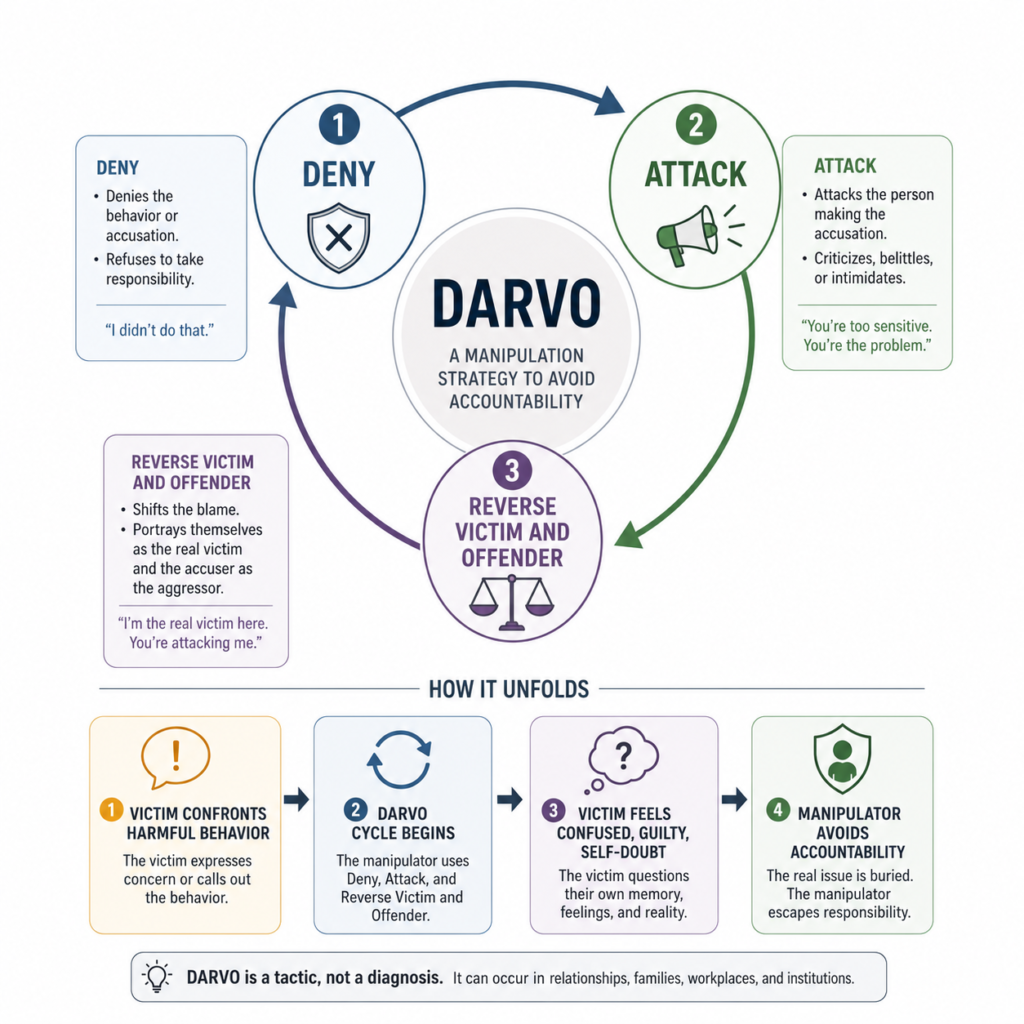
DARVO stands for Deny, Attack, and Reverse Victim and Offender. It describes a defensive response in which someone accused of wrongdoing denies the behavior, attacks the person raising the concern, and then presents themselves as the victim while portraying the actual victim as the offender.
The term describes a predictable response pattern that some people use when confronted about harmful behavior.
Rather than accepting responsibility, the individual follows three distinct steps. First, they deny the behavior.
Next, they attack the person who raised the concern. Finally, they reverse the roles, presenting themselves as the true victim while portraying the actual victim as the offender.
Although these steps may unfold within minutes, they often leave the other person emotionally overwhelmed.
Consequently, the original issue becomes buried beneath confusion, guilt, and self doubt.
For example, imagine a partner who secretly spends a large amount of shared savings without discussing it.
When confronted, they might respond like this:”I never spent that money without telling you. “Afterward, they add:”You are always suspicious.”
You never appreciate everything I do.”Finally, they conclude:”I cannot believe you are attacking me after everything I sacrifice for this family.
“Notice how the conversation has completely changed. Instead of discussing financial honesty, the focus shifts toward defending the accused person’s feelings.
Meanwhile, the person who raised a legitimate concern begins questioning whether speaking up was wrong.
This emotional reversal is the defining feature of DARVO. Importantly, DARVO is not simply lying or making excuses.
Instead, it represents a coordinated pattern that protects the individual’s self image while undermining the confidence of the other person.
The Origin of DARVO
The concept of DARVO was developed by psychologist Jennifer J. Freyd, whose research has significantly influenced the study of interpersonal trauma, institutional betrayal, and memory.

Freyd observed that many individuals accused of abusive or unethical behavior responded in remarkably similar ways.
Instead of acknowledging the allegations, they frequently denied the events, attacked the credibility of the person reporting them, and ultimately portrayed themselves as the true victims.
Her work demonstrated that this response pattern appears across many settings, including intimate relationships, families, workplaces, educational institutions, and organizations.
Furthermore, research suggests that observers may sometimes sympathize with the accused when DARVO is used effectively, especially if they lack full information about the situation.
This insight has made DARVO an important concept in trauma psychology because it helps explain why victims often struggle to be believed and why manipulation can distort both personal relationships and public perceptions.
Why Understanding DARVO Matters
Recognizing DARVO is not about labeling every disagreement as abuse.
Healthy relationships involve misunderstandings, emotional reactions, and occasional defensiveness.
However, healthy individuals generally become willing to reflect, apologize, and repair the relationship over time.
By contrast, repeated DARVO shifts responsibility away from harmful behavior and places the emotional burden on the person who was originally hurt.
Over time, this pattern can erode trust, increase anxiety, and contribute to chronic self doubt.
Moreover, prolonged exposure to DARVO may influence how victims perceive reality. Many survivors describe feeling mentally exhausted because they constantly replay conversations, searching for mistakes they never actually made.a
Eventually, they may stop expressing concerns altogether simply to avoid another emotionally draining confrontation.
Understanding DARVO therefore serves two important purposes. First, it helps people identify manipulation more accurately.
Second, it empowers them to maintain healthier boundaries and seek appropriate support when necessary.
The Psychology Behind DARVO
Understanding DARVO requires looking beyond the words people say.
Instead, we need to examine the psychological processes that make this manipulation strategy so effective.
While the behavior may appear spontaneous, it often follows predictable patterns that influence emotions, memory, and social perception.
Many people assume that manipulation only works on individuals who are insecure or emotionally vulnerable. However, research suggests otherwise.
Even confident, emotionally healthy people can become confused when they repeatedly experience DARVO. That is because this tactic targets normal psychological processes that humans rely on every day.
As a result, victims often leave conversations feeling guilty even when the evidence supports their concerns.
Why DARVO Feels So Convincing
One of the most powerful aspects of DARVO is its ability to redirect attention.
Instead of discussing the harmful behavior, the conversation suddenly becomes about the victim’s reaction.
For example, imagine confronting a close friend about repeatedly sharing your private information.
Instead of responding to your concern, the friend says:”I cannot believe you think I would betray you. After everything I have done for you, this accusation is incredibly hurtful.”Within seconds, the discussion changes.
Rather than examining the breach of trust, you may begin wondering whether you were too harsh.
This shift happens because the human brain naturally responds to emotional conflict. When someone appears deeply hurt, many people instinctively try to reduce tension.
Consequently, accountability disappears while emotional reassurance takes its place.
Therefore, DARVO often succeeds because it changes the emotional focus before the logical mind has time to evaluate the facts.
How the Brain Responds to DARVO
The brain constantly tries to maintain a sense of safety and predictability. When someone unexpectedly attacks us after we express a concern, the nervous system can interpret the interaction as a threat.
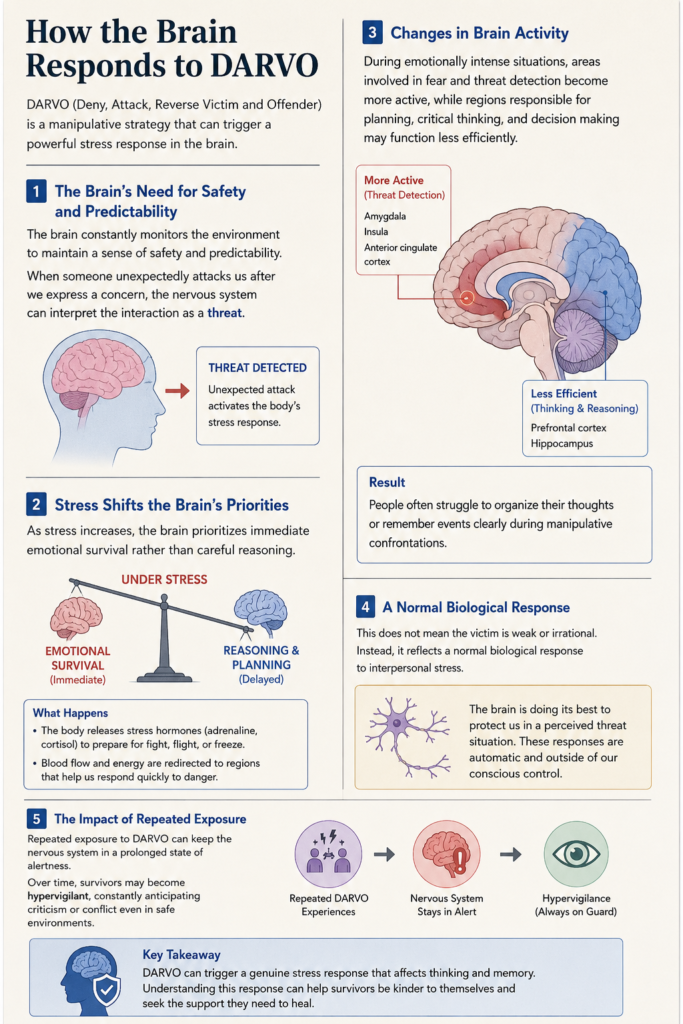
As stress increases, the brain prioritizes immediate emotional survival rather than careful reasoning.
During emotionally intense situations, areas involved in fear and threat detection become more active, while regions responsible for planning, critical thinking, and decision making may function less efficiently.
Consequently, people often struggle to organize their thoughts or remember events clearly during manipulative confrontations.This does not mean the victim is weak or irrational.
Why Victims Begin to Doubt Themselves
Perhaps the most damaging consequence of DARVO is persistent self doubt.Initially, victims trust their own observations.
However, after repeated denial, criticism, and role reversal, they often begin questioning their memory, intentions, and judgment.Several psychological mechanisms contribute to this process.
First, people generally assume that close relationships are based on honesty. Therefore, when someone confidently denies obvious events, the victim often searches for flaws in their own memory before assuming deliberate manipulation.
Second, most individuals want to believe they are fair and compassionate. Consequently, accusations such as “You are selfish” or “You are the abusive one” can trigger intense self examination.
Finally, repeated emotional pressure gradually weakens confidence. As uncertainty grows, victims may rely more heavily on the manipulator’s interpretation of events than on their own experiences.
This gradual erosion of self trust explains why many survivors say they felt as though they had “lost themselves” during emotionally abusive relationships.
Cognitive Biases That Make DARVO Effective
Several well established psychological principles help explain why DARVO can influence both victims and observers.
Confirmation Bias
People naturally look for information that supports what they already believe.
If friends, coworkers, or family members already view the accused person as kind or trustworthy, they may unintentionally dismiss evidence that contradicts this positive image.
Consequently, the manipulator’s version of events may appear more believable than the victim’s account.
The Fundamental Attribution Error
People often explain their own mistakes by considering circumstances.
However, they frequently explain other people’s behavior by assuming personality flaws.a
Therefore, observers may interpret the victim’s emotional response as evidence that they are unstable while viewing the accused person’s behavior as understandable.
The Just World Hypothesis
Many people prefer believing that good things happen to good people and bad things happen to those who deserve them.
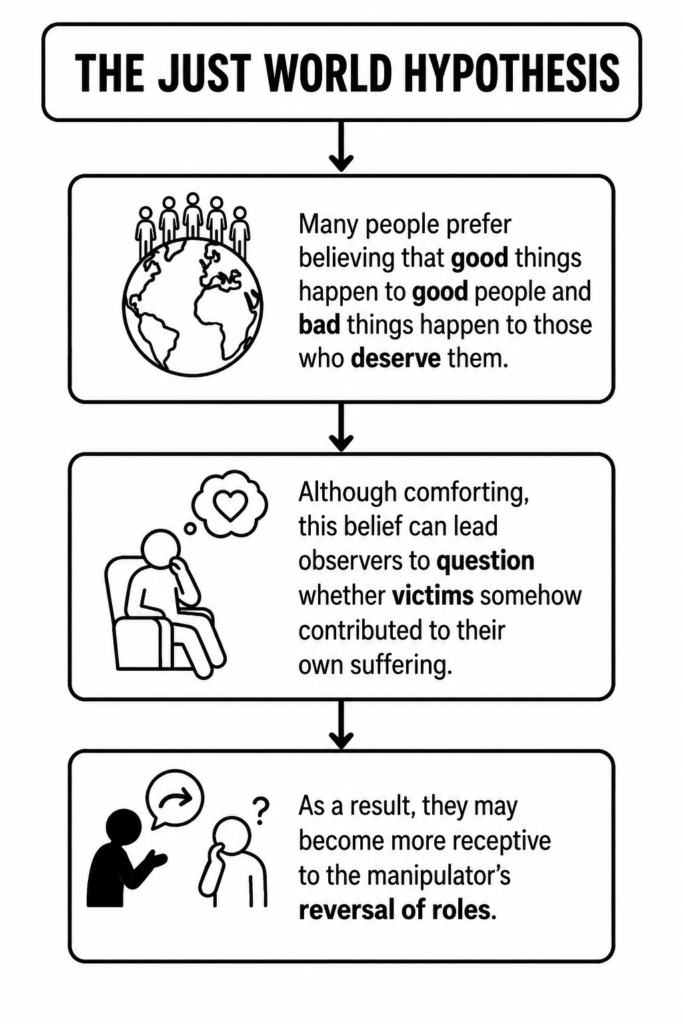
Although comforting, this belief can lead observers to question whether victims somehow contributed to their own suffering.
As a result, they may become more receptive to the manipulator’s reversal of roles.
Cognitive Dissonance
People experience psychological discomfort when new information challenges their existing beliefs.
If someone has always believed a respected family member, community leader, or partner is caring and trustworthy, accepting evidence of harmful behavior creates internal conflict.
To reduce that discomfort, some people unconsciously accept the DARVO narrative because it feels psychologically easier than changing their long held beliefs.
DARVO, Trauma, and Memory
Contrary to popular myths, trauma does not always produce perfect memory. Instead, highly stressful experiences often affect how memories are stored and recalled.
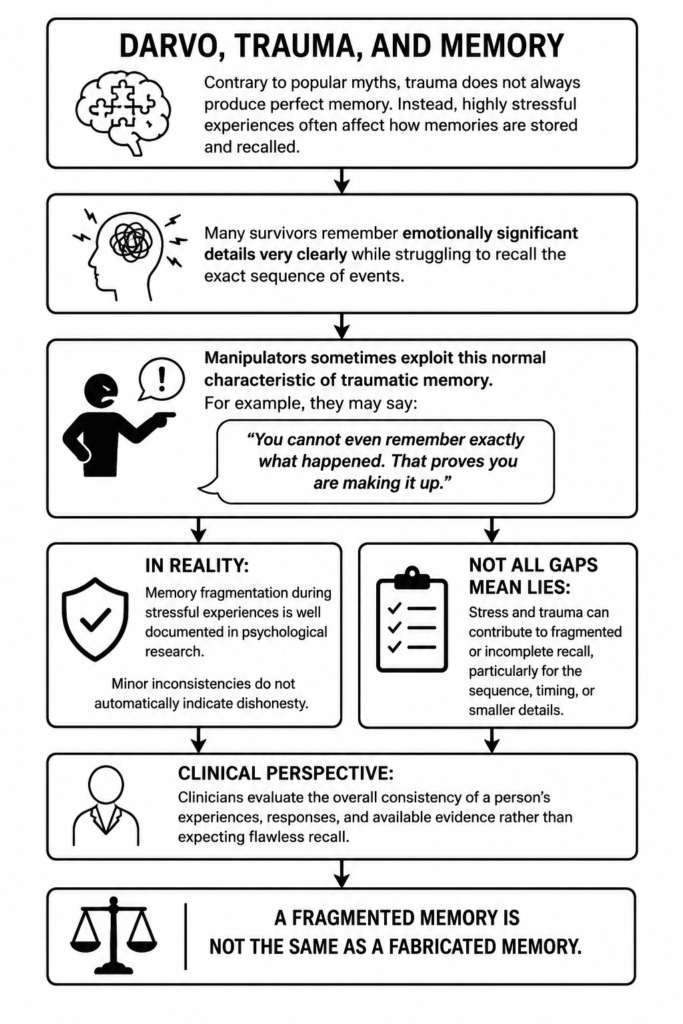
Many survivors remember emotionally significant details very clearly while struggling to recall the exact sequence of events.
Manipulators sometimes exploit this normal characteristic of traumatic memory.For example, they may say:”You cannot even remember exactly what happened. That proves you are making it up.”In reality, memory fragmentation during stressful experiences is well documented in psychological research. Minor inconsistencies do not automatically indicate dishonesty.Therefore, clinicians evaluate the overall consistency of a person’s experiences rather than expecting flawless recall.
DARVO Is Different From Gaslighting
Although people often use these terms interchangeably, DARVO and gaslighting describe different psychological processes.
Gaslighting primarily aims to make another person question their perception of reality.By contrast, DARVO focuses on escaping responsibility through denial, personal attacks, and role reversal.
Nevertheless, both strategies frequently occur together.For instance, someone might first deny harmful behavior, then insist the victim imagined the event, and finally accuse the victim of being abusive.
When combined, these tactics can create profound confusion and emotional exhaustion.
DARVO Is Not Always Linked to Narcissistic Personality Disorder
Many online discussions suggest that DARVO only occurs in narcissistic personality disorder.
However, the evidence does not support such a broad conclusion.People may use DARVO for different reasons, including shame, fear of consequences, poor emotional regulation, learned family patterns, or other personality traits.
Although the behavior is commonly discussed in the context of narcissistic abuse, DARVO itself is a manipulation strategy rather than a diagnostic criterion.
Therefore, it is important to avoid diagnosing someone based solely on this behavior.
Accurate diagnosis requires a comprehensive clinical assessment by a qualified mental health professional.
Clinical Perspective on DARVO
From a clinical perspective, DARVO is best understood as a defensive interpersonal response rather than a formal psychiatric diagnosis.
Mental health professionals do not diagnose someone with “DARVO.” Instead, clinicians examine the broader context, including personality functioning, trauma history, attachment patterns, emotional regulation, and relationship dynamics.
Psychologists also recognize that people can occasionally become defensive without engaging in the full DARVO pattern.
The distinguishing feature is the repeated and systematic reversal of responsibility that protects the individual from accountability while harming the other person’s psychological well being.
For therapists, identifying DARVO can help explain why some clients report chronic confusion, excessive guilt, and difficulty trusting their own perceptions despite having clear memories of emotional harm.
DARVO in Narcissistic Abuse
Although DARVO is not exclusive to narcissistic personalities, it appears frequently in relationships characterized by narcissistic abuse.
In these relationships, accountability threatens the individual’s carefully maintained self image. Consequently, admitting wrongdoing may feel intolerable because it creates intense shame and exposes vulnerabilities that the person desperately wants to hide.
Instead of reflecting on their behavior, they often redirect attention toward the victim. As a result, conversations become emotionally exhausting rather than productive.
For example, imagine confronting your partner after discovering repeated lies about finances.Rather than discussing the deception, they respond by saying:”You are obsessed with controlling me. I cannot believe you invaded my privacy.
I am the one who feels unsafe in this relationship.”Within moments, the original concern disappears. Instead, you find yourself defending your intentions rather than discussing the dishonesty that prompted the conversation.
Over time, this pattern conditions victims to remain silent because speaking up consistently leads to emotional punishment.
DARVO in Families
Families provide one of the earliest environments where people learn communication patterns.
Unfortunately, DARVO can become deeply ingrained when parents or caregivers repeatedly avoid responsibility.
Unlike isolated disagreements, chronic DARVO teaches children that expressing emotions carries consequences.
Therefore, many children learn to suppress their feelings simply to preserve peace within the family.
Consider this example.A teenager calmly says,”It hurt when you embarrassed me in front of everyone.”Instead of listening, the parent replies,”I sacrificed everything for you. You are selfish and ungrateful.
Now I am the bad parent because I care about your future.”The discussion no longer centers on the child’s emotional experience.
Instead, the parent positions themselves as the victim while portraying the child as disrespectful.
Repeated experiences like this can shape a child’s beliefs about relationships for many years.
Long Term Effects of DARVO During Childhood
Children depend on caregivers to help them understand reality. Consequently, repeated exposure to DARVO may interfere with healthy emotional development.
Many adults who experienced this pattern during childhood describe similar struggles later in life.These may include:
- Chronic self doubt
- Excessive guilt
- Difficulty setting boundaries
- Fear of conflict
- People pleasing behaviors
- Perfectionism
- Anxiety within close relationships
- Difficulty trusting personal memories
- Constant need for external validation
Importantly, these reactions are understandable adaptations to confusing interpersonal environments rather than signs of personal weakness.
DARVO in Romantic Relationships
Healthy relationships require accountability, empathy, and repair after conflict.
However, DARVO interrupts all three processes.Initially, the relationship may appear loving and supportive.
Nevertheless, as conflicts increase, every concern becomes an opportunity for role reversal.
For instance, one partner says,”I felt hurt when you ignored my messages all weekend.”The response becomes,”You are incredibly demanding.
Nothing I do is ever enough. You are emotionally abusive because you constantly criticize me.
“Eventually, the injured partner begins apologizing simply to end the argument.As this cycle repeats, emotional intimacy gradually declines because honest communication no longer feels safe.
The Cycle of DARVO in Relationships
Many survivors describe DARVO as following a predictable cycle.
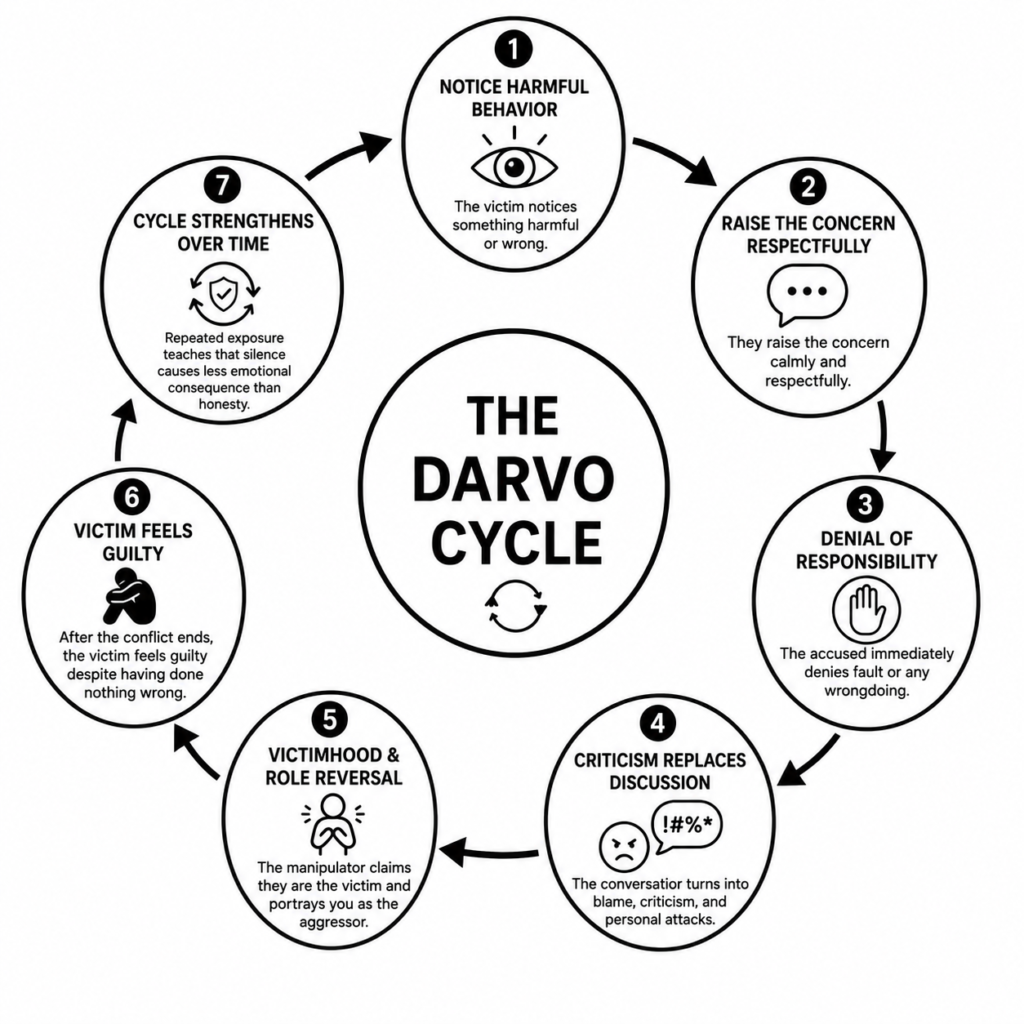
First, the victim notices harmful behavior.
Next, they raise the concern respectfully.
The accused person immediately denies responsibility.
Soon afterward, criticism replaces discussion.
Finally, the manipulator claims victimhood while portraying the actual victim as the aggressor.
After the conflict ends, the victim often feels guilty despite having done nothing wrong.
Unfortunately, repeated exposure strengthens this cycle because the victim learns that silence creates fewer emotional consequences than honesty.
DARVO in the Workplace
Although DARVO is commonly discussed in personal relationships, it can also appear in professional environments.
For example, an employee respectfully reports repeated bullying by a supervisor.Instead of addressing the complaint, the supervisor states,”This employee constantly attacks my leadership.
I am being harassed simply for maintaining standards.”If organizational leaders fail to investigate objectively, attention may shift toward the employee’s behavior instead of the reported misconduct.
Consequently, workplace morale declines while genuine concerns remain unresolved.
Organizations that encourage transparency, fair investigations, and psychological safety are generally less vulnerable to these manipulation patterns.
Institutional DARVO
Psychologist Jennifer J. Freyd also introduced the concept of institutional betrayal, which helps explain how organizations may unintentionally reinforce DARVO.
Institutional betrayal occurs when schools, workplaces, religious organizations, sports organizations, or other institutions fail to protect individuals who report harm.
For example, an employee reports persistent harassment.Instead of conducting an impartial investigation, the organization questions the employee’s motives, minimizes the complaint, or praises the accused person’s reputation.
As a result, the institution may unknowingly amplify DARVO, leaving victims feeling isolated while protecting those in positions of power.
Research suggests that institutional responses significantly influence psychological recovery after traumatic experiences.
Therefore, supportive organizational practices play an important role in reducing long term harm.
DARVO and Trauma Bonding
Repeated DARVO may contribute to trauma bonding when periods of emotional harm alternate with affection, apologies, or temporary kindness.
Following an intense conflict, the manipulative person may suddenly become loving, attentive, or remorseful.
Consequently, the victim experiences emotional relief.Over time, this unpredictable pattern strengthens emotional attachment because the brain begins associating occasional kindness with safety after prolonged distress.
Importantly, trauma bonding does not mean someone enjoys abuse or willingly remains in harmful situations.
Instead, it reflects complex psychological and neurobiological processes that can develop in relationships characterized by intermittent reinforcement.
Understanding this distinction helps reduce shame and encourages more compassionate approaches to recovery.
Attachment Theory and DARVO
Attachment theory also offers valuable insight into DARVO.
Individuals with insecure attachment patterns may react defensively when confronted because criticism activates deep fears of rejection or inadequacy.
However, insecure attachment alone does not justify manipulation.
Healthy adults gradually learn emotional regulation, accountability, and effective conflict resolution.
Therefore, while attachment history may help explain certain defensive reactions, it should never excuse persistent patterns of emotional manipulation or abuse.
Recognizing this distinction allows clinicians to maintain empathy without minimizing the impact of harmful behavior.
Can People Who Use DARVO Change?
This question has no simple answer. The possibility of change depends on several factors, including the person’s willingness to accept responsibility, their capacity for self reflection, the presence of underlying mental health conditions, and their commitment to long term treatment.
Occasional defensiveness is part of being human. Most people become defensive when they feel embarrassed, criticized, or ashamed.
However, emotionally healthy individuals usually regain perspective, acknowledge their role, and attempt to repair the relationship.
By contrast, someone who repeatedly relies on DARVO often protects their self image at the expense of another person’s psychological wellbeing.
Unless they recognize this pattern and actively work to change it, the behavior is likely to continue.
Research in personality psychology suggests that lasting change is possible, but it typically requires consistent motivation, accountability, and structured psychotherapy.
Change rarely occurs because another person argues more effectively or sacrifices more of themselves.
Therefore, loved ones should avoid believing that they alone can transform someone who persistently refuses responsibility.
Clinical Treatment Perspective
From a clinical standpoint, DARVO itself is not a mental disorder and it is not listed as a diagnosis in major diagnostic manuals such as the DSM 5 TR or the ICD 11.
Instead, mental health professionals assess the broader clinical picture.
For example, a psychologist or psychiatrist may evaluate:
- Personality functioning
- Emotional regulation
- Trauma history
- Attachment style
- Cognitive patterns
- Relationship history
Coexisting mental health conditionsTreatment focuses on these underlying factors rather than on DARVO alone.Evidence based therapies that may help depending on the individual’s needs include:
- Cognitive Behavioral Therapy
- Dialectical Behavior Therapy
- Schema Therapy
- Mentalization Based Therapy
- Psychodynamic Psychotherapy
- Trauma focused therapies when trauma is present
How to Respond to DARVO
Recognizing DARVO is only the first step. Responding effectively often requires emotional regulation, clear boundaries, and realistic expectations.The following strategies may help.
Stay Focused on the Original Issue
Manipulation succeeds when the conversation moves away from the initial concern.Instead of defending every accusation, gently return to the original topic.
For example:”We can discuss your concerns later. Right now I would like to stay focused on the issue I raised.”Remaining calm does not guarantee cooperation, but it reduces the likelihood of becoming trapped in endless circular arguments.
Trust Documented Facts
Repeated DARVO often creates confusion.Keeping written records, saving important messages, or documenting significant events may help you maintain confidence in your own experiences.
Documentation should never become an obsession. Instead, it can serve as a practical tool when persistent manipulation causes chronic self doubt.
Avoid Endless Debates
Many survivors believe they simply have not explained themselves clearly enough.
Unfortunately, DARVO is rarely about misunderstanding.If someone consistently refuses accountability despite clear evidence, repeating the same conversation usually produces the same outcome.
Sometimes protecting your emotional wellbeing requires ending an unproductive discussion rather than winning it.
Maintain Healthy Boundaries
Boundaries define what you are willing to accept within a relationship.
For example, you might say:”I am willing to continue this conversation when we can both discuss the issue respectfully.”Healthy boundaries are not punishments.
Instead, they protect emotional safety while encouraging respectful communication.
Related Articles
What Is Real Depression? How Clinical Depression Is Different?
Why does a narcissist smear your name
Trauma Bond: Why Your Mind Keeps Returning to the abuse
Yes. Some individuals may have learned defensive communication patterns during childhood and may not fully recognize their impact. Nevertheless, lack of awareness does not eliminate responsibility for harmful behavior.
Therapy can be beneficial when the individual genuinely wants to change and remains willing to examine uncomfortable patterns honestly. Progress is much less likely when the person refuses accountability.
Healthy misunderstandings usually involve curiosity, clarification, empathy, and eventual repair. DARVO repeatedly redirects responsibility while portraying the person raising the concern as the problem.
References
- Freyd, J. J. (1997). Violations of power, adaptive blindness, and betrayal trauma theory. Feminism & Psychology, 7(1), 22–32.
- Harsey, S. J., & Freyd, J. J. (2022). Defamation and DARVO. Journal of Trauma & Dissociation, 23(5), 481–489.
- Durland, M., Harsey, S., & Freyd, J. J. (1997). Assessing perpetrator responses to confrontation: Associations with a DARVO-SF and post-trauma symptoms in two different populations. Journal of Trauma & Dissociation, 27, 221–237.
- Rosenthal, M. N., & Freyd, J. J. (2022). From DARVO to distress: College women’s contact with their perpetrators after sexual assault. Journal of Aggression, Maltreatment & Trauma, 31, 459–477.
Reviewed by Ainna Ross
This article is grounded in published psychological research and my own experience recovering from narcissistic abuse. Read more about my background. It's for educational purposes only and isn't a substitute for professional diagnosis or care.
Need support right now? In the US, call or text 988 (Suicide & Crisis Lifeline). In the UK, call Samaritans free on 116 123. If you're in immediate danger, contact your local emergency services.
